Robotic Welding & Cutting Systems
Robotic Welding & Cutting Systems
Robotic Welding & Cutting Systems are advanced automated solutions designed to perform high-precision welding and cutting operations with greater speed, consistency, and repeatability. These systems integrate industrial robots with welding power sources, cutting equipment, positioners, sensors, and specialized software to automate complex manufacturing processes.
The robot arm serves as the primary component for welding and cutting operations. It consists of various joints and an end-effector—a specialized device, such as a welding torch or a gripper for holding electrodes, mounted at the end of the arm to perform specific tasks.
Sensors are critical to robotic welding and cutting systems, providing essential data regarding the workpiece's position, orientation, and other key characteristics. Vision systems are often employed to ensure precise object tracking and alignment. The controller acts as the brain of the robotic system, coordinating arm movements, interpreting programming, managing sensor input, and ensuring the system operates within established safety parameters.
Robotic welding systems are highly precise machines programmed to follow specific paths. They can be programmed offline using CAD and CAM software. These welding processes rely on a power source to provide the electrical energy needed to create an arc, while cutting systems utilize plasma or laser sources.
Robotic welding and cutting equipment is often integrated into larger production environments. These units may form part of a flexible manufacturing system (FMS), allowing them to adapt to diverse production requirements.
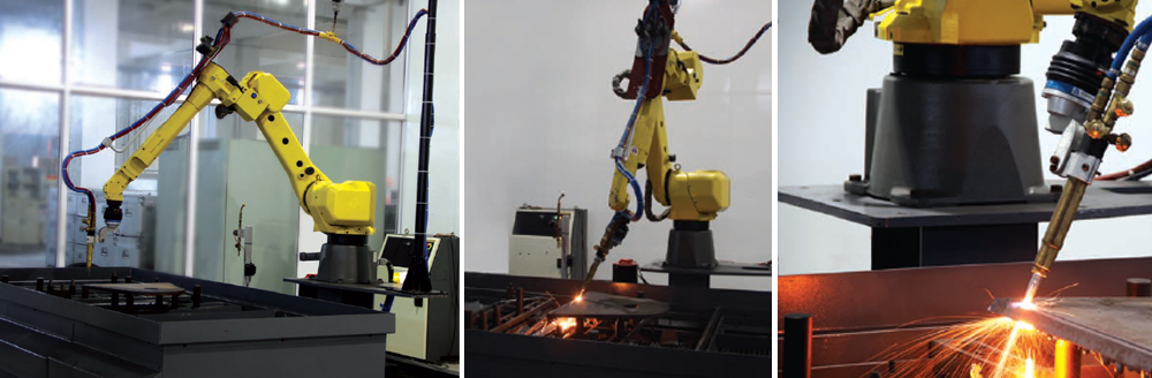
Key Features of Robotic Welding & Cutting Systems :
Robotic Welding & Cutting Systems are automated solutions designed to improve productivity, precision, consistency, and safety in industrial fabrication and manufacturing processes.
Key Features :
- High Precision & Accuracy : Ensures accurate welding and cutting along programmed paths with minimal dimensional variation.
- Consistent Quality : Delivers uniform weld quality, cutting accuracy, and repeatable results across multiple components.
- High-Speed Production : Enables faster welding and cutting cycles, increasing overall production output.
- Programmable Robotic Operation : Robots can be programmed for complex welding and cutting sequences, patterns, and component geometries.
- Multi-Axis Movement : Advanced robotic arms provide multi-axis movement for accessing difficult-to-reach areas and complex profiles.
- Automated Welding Control : Precise control of welding parameters such as current, voltage, wire feed speed, travel speed, and shielding gas.
- Automated Cutting : Compatible with technologies such as plasma, oxy-fuel, and laser cutting, depending on the system configuration.
- Flexible Production : Suitable for different component sizes, shapes, materials, and production requirements with appropriate tooling and programming.
- Integrated Sensors & Monitoring : Sensors can monitor parameters such as torch position, seam location, arc conditions, and component alignment.
- Torch & Tool Management : Automatic torch cleaning, wire cutting, tool changing, and other auxiliary functions can be integrated.
- Reduced Human Intervention : Minimizes manual handling and repetitive operations, allowing operators to focus on supervision and quality control.
- Improved Workplace Safety : Keeps operators away from welding arcs, sparks, fumes, heat, and other hazardous process areas.
- Lower Material Wastage : Accurate control of welding and cutting parameters helps reduce excessive weld deposition and cutting scrap.
- Easy Integration with Production Lines : Can be integrated with fixtures, positioners, conveyors, safety enclosures, extraction systems, and other automation equipment.
- High Repeatability : Maintains consistent positioning and process execution for high-volume manufacturing.
- Data & Process Monitoring : Advanced systems can record production parameters, cycle times, alarms, and process information for quality tracking.
- Suitable for Continuous Operation : Designed for extended production cycles with reduced fatigue compared with manual operations.
- Customizable System Configuration : Robotic cells can be designed according to component geometry, production volume, welding/cutting process, and available floor space
Structure of Robotic Welding & Cutting Systems :
Robotic Welding & Cutting Systems consist of several integrated mechanical, electrical, control, and safety components that work together to automate welding and cutting operations with high precision, consistency, and productivity.
Together, these components create a complete Robotic Welding & Cutting System capable of delivering repeatable, high-speed, and precise production while reducing manual intervention and improving workplace safety.
- Industrial Robotic Arm : The robotic arm is the primary motion unit of the system. It provides multi-axis movement and accurately positions the welding torch or cutting tool according to the programmed path.
- Welding Power Source : For robotic welding applications, a suitable welding power source supplies controlled electrical current and voltage. It enables accurate adjustment of parameters such as Welding current, Voltage, Wire feed speed, Welding mode, Pulse characteristics.
- Welding Torch / Cutting Head :
- o Welding Torch : Delivers the welding arc, shielding gas, and consumable wire to the workpiece.
- o Cutting Head : Performs precise cutting using processes such as plasma, laser, or oxy-fuel cutting.
- o The tool selection depends on material, thickness, cutting/welding process, and application.
- Robot Controller : The controller acts as the central processing unit of the robotic system. It controls robot movement, welding/cutting parameters, process sequences, and communication with peripheral equipment.
- Positioner : A positioner rotates or tilts the workpiece so that the robot can access different welding or cutting locations. Common configurations include Single-axis positioners, Two-axis positioners, Head stock-tailstock systems and Rotary tables.
- Fixtures & Clamping Systems : Fixtures securely hold and accurately locate the workpiece during welding or cutting. Proper fixturing helps maintain dimensional accuracy and repeatability while minimizing workpiece movement.
- Sensors & Vision Systems : Sensors can detect the actual position of the joint or cutting path and compensate for variations in workpiece positioning. This helps maintain consistent weld quality and cutting accuracy.
- Safety System : Safety components protect operators and equipment during automated operation. These may include Safety fencing, Interlocked access doors, Emergency-stop switches, Safety scanners or light curtains, Safety relays/controllers and Warning indicators.
- Fume Extraction System : For welding and plasma cutting applications, fume extraction systems remove smoke, fumes, and airborne contaminants from the working area, helping maintain a cleaner and safer production environment.
- Electrical Control Panel : The electrical control panel houses the system's electrical and control components, including PLCs, circuit protection, contactors, relays, drives, and communication modules.
- Welding Torch Cleaning Station : A torch cleaning station automatically removes weld spatter and deposits from the torch nozzle. It may also include nozzle reaming, anti-spatter application, and tip maintenance functions.
- Gas Supply System : The gas system supplies shielding or cutting gases at controlled pressure and flow rates. Depending on the process, gases may include argon, carbon dioxide, oxygen, nitrogen, or gas mixtures.
- Cutting Table / Welding Cell : The work area may consist of a dedicated robotic welding cell, cutting table, or enclosed automation cell designed to accommodate the robot, workpiece, fixtures, extraction system, and safety equipment.
- Cooling System : Water- or air-cooling systems may be provided for high-duty-cycle welding torches, cutting heads, power sources, and other components that generate significant heat.
Typical Robotic Welding & Cutting Operations :
Depending on the production requirement, a robotic system can be configured for MIG/MAG, TIG, plasma cutting, laser cutting, oxy-fuel cutting, and other automated processes. The robot can follow programmed paths while maintaining controlled torch angle, travel speed, and process parameters.
Applications industries using Robotic Welding & Cutting Systems :
Robotic Welding & Cutting Systems are particularly valuable in automotive, heavy engineering, fabrication, construction equipment, railway, agricultural machinery, pressure vessels, shipbuilding, energy, and industrial manufacturing, where repetitive and high-precision metal fabrication is required.
- Automotive and auto-component manufacturing : Used for welding vehicle chassis, body components, exhaust systems, frames, brackets, and structural assemblies. Ideal for manufacturing seats, suspension components, transmission parts, wheel assemblies, and other fabricated components.
- Heavy engineering industries : Used for welding large and heavy structures, machinery frames, equipment components, and fabricated assemblies.
- Structural fabrication : Robotic systems are used for repetitive welding and precision cutting of beams, frames, supports, platforms, and structural components.
- Pressure vessel manufacturing : Used for automated welding of tanks, pressure vessels, boilers, heat exchangers, and related components, depending on the application and applicable welding procedures
- Construction equipment : Applications include welding excavator components, loader frames, crane parts, earthmoving equipment, and structural assemblies.
- Agricultural machinery : Suitable for manufacturing tractors, harvesters, agricultural implements, trailers, and equipment frames.
- Railway components : Used for manufacturing railway coaches, bogies, structural frames, undercarriages, and other welded components.
- Industrial machinery : Used for welding machine frames, enclosures, housings, brackets, structural components, and fabricated machinery.
- Pipe and tube fabrication : Used for welding pipe assemblies, tube structures, manifolds, frames, and other tubular components.
- Shipbuilding & Marine Industry : Used for welding ship structures, decks, frames, panels, marine equipment, and other large, fabricated components.
- Defense & Aerospace Industry : Suitable for precision welding and cutting of specialized metal components and assemblies where repeatability and process control are critical.
- Mining & Material Handling Industry : Used for manufacturing conveyor structures, buckets, hoppers, frames, heavy-duty equipment, and material-handling components.
- Renewable Energy Industry : Applications include fabrication of solar mounting structures, wind-energy components, equipment frames, and other metal assemblies.
- Electrical & Electronics Equipment Industry : Used for welding electrical enclosures, control-panel cabinets, equipment frames, and metal housings.
- HVAC & Sheet Metal Industry : Robotic cutting and welding systems can automate fabrication of ducts, cabinets, housings, frames, and sheet-metal assemblies.
FAQs of Robotic Welding & Cutting Systems:
What types of welding can robots perform?
Depending on the configuration, robotic systems can perform processes such as:
- MIG/MAG welding
- TIG welding
- Spot welding
- Arc welding
- Laser welding
- Submerged arc welding
What cutting operations can be automated?
Robotic cutting systems can be configured for plasma cutting, oxy-fuel cutting, laser cutting, and other thermal cutting processes, depending on material, thickness, and production requirements.
Can robotic systems detect welding or cutting errors?
Advanced systems can incorporate sensors and monitoring technologies to detect deviations in joint position, arc conditions, torch position, or other process parameters. The level of monitoring depends on the system configuration.
What safety features are provided in robotic welding systems?
Safety features may include safety fencing or enclosures, interlocked access doors, emergency-stop systems, safety scanners, warning lights, and controlled operating zones. The exact safety arrangement depends on the installation and applicable standard.
What factors should be considered before selecting a robotic system?
Important factors include:
- Component size and geometry
- Material and thickness
- Welding/cutting process
- Production volume
- Required cycle time
- Robot payload and reach
- Fixture requirements
- Required accuracy
- Available floor space
- Integration and automation requirements
Can welding and cutting operations be integrated into one robotic cell?
Yes. Depending on the application, a robotic cell can be designed with multiple tools, positioners, fixtures, and process equipment to perform different automated fabrication operations.
How can robotic welding reduce manufacturing costs?
Robotic automation can reduce costs by improving productivity, minimizing rework and scrap, optimizing consumable usage, reducing downtime, and allowing consistent operation over extended production periods.
How do I choose the right Robotic Welding & Cutting System?
The right system should be selected based on the component design, material, welding or cutting process, production volume, cycle-time requirements, accuracy, available workspace, automation objectives, and future production requirements. A customized application study is recommended before finalizing the system.